Table of Contents
Before you begin
Buying a board game table is a decision that goes far beyond simply acquiring a piece of furniture. It means creating a space to enjoy a hobby that brings family and friends together for hours, protecting games that in many cases have great economic and sentimental value, and having a place designed to make each game more comfortable.
Most hobbyists start out playing on the dining room table. It's the most logical option and, for a while, it's usually sufficient. However, as the collection grows and the games become more ambitious, the same situations begin to appear again and again: lack of space for the components, having to dismantle a campaign because it's dinnertime, or finding it impossible to leave a game ready to continue the next day.
That's precisely where a table designed for gaming makes all the difference.
Its purpose is not simple to provide an indoor gaming area. It must also offer comfort during long gaming sessions, protect the components when the table is closed, and continue to blend seamlessly into the living room or dining room like any other quality piece of furniture.
In recent years, the selection has grown considerably. Today, there are manufacturers from many countries, using a wide variety of materials, with different tabletop systems, play area depths, accessories, and levels of customization. At first glance, many tables appear similar, but after years of use, significant differences emerge that are rarely visible in a photograph.
That's why it's a good idea to take some time to compare before making a decision.
In this guide we will analyze the aspects that really influence the user experience: the right size, the materials, the depth of the play area, the mat, the accessories, the build quality and the most common mistakes to avoid before making this type of investment.

Our experience as manufacturers For over ten years, we've designed and manufactured tables for clients across Europe. During that time, we've answered thousands of inquiries, and interestingly, almost all of them revolve around the same questions: what size to choose, which materials are the best choice, what depth is most comfortable, and which accessories are truly worthwhile. This guide brings together everything we´ve learned to help you make an informed decision.
What exactly is a board game table?
At first glance, it might look like a conventional table with a few added accessories. However, a true gaming table has been designed from the ground up to solve problems that any enthusiast will inevitably encounter over time.
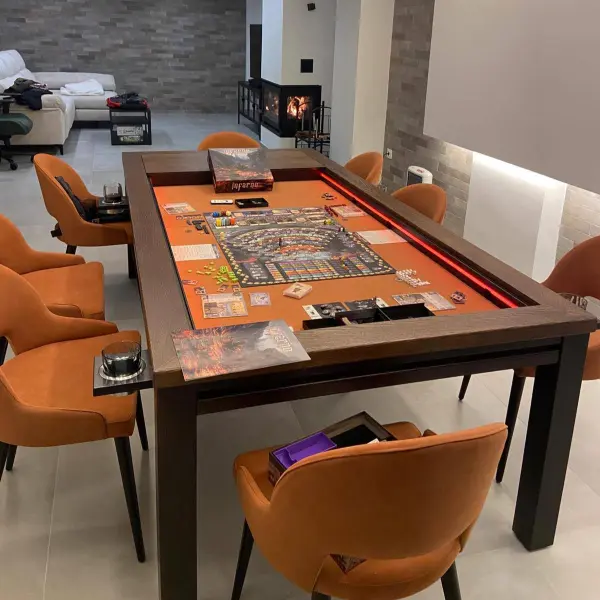
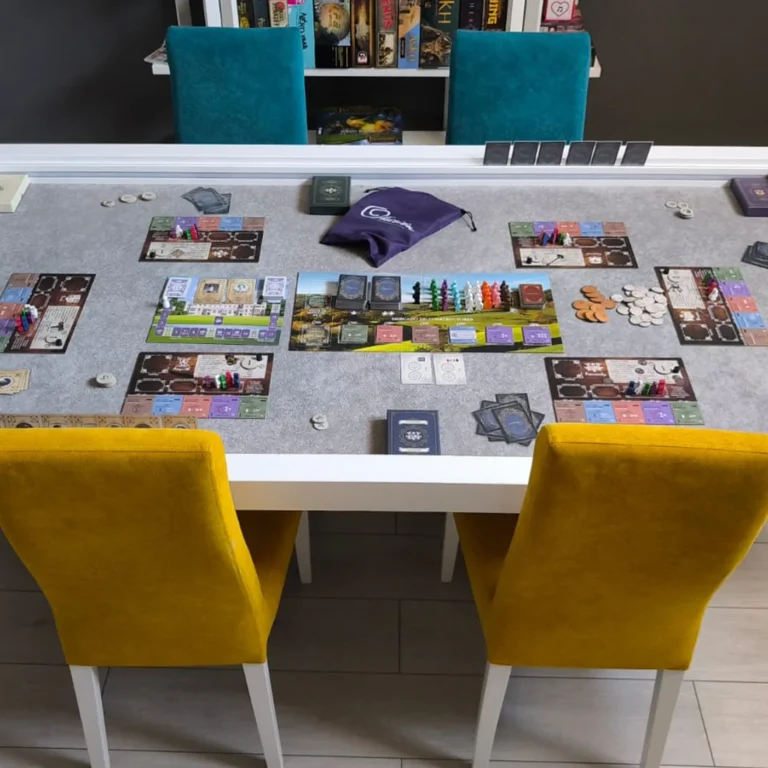
The most well-known feature is the recessed play area, a space located under the lids where the board and all components remain protected when the table is closed.
This solution allows you to leave a game set up for days or even weeks. There's no longer any need to collect hundreds of cards, miniatures, or tokens after each session. Simply replace the covers, and the table is ready to be used normally again for eating, working, or studying.
But a good table offers much more than that possibility.
The layout of the space, the depth of the play area, the structural stability, and the quality of the lids all directly influence comfort during long gaming sessions. These are details that often go unnoticed before purchase, but that end up making all the difference after hundreds of hours of use.
It is also worth remembering that not all players are looking for the same thing.
A family that enjoys casual gaming has very different needs than a group that organizes Gloomhaven campaigns, Twilight Imperium games, or weekends dedicated to wargames.
That's why there is no perfect table for everyone.
The best choice will always be the one that suits your play style, the space available in your home, and the actual use you will give it over the next few years.

Why are more and more gamers buying a board game table?
A few years ago, it was difficult to find a table specifically designed for board games. Most gamers used their dining room table and adapted to its limitations.
Actually, almost all of us started out the same way.
One afternoon you take out a game, unfold the board, and enjoy the game without giving much thought to the space. But over time, larger games arrive, campaigns that last several sessions, and collections with hundreds of components. That's when small inconveniences begin to appear, which, little by little, end up detracting from the comfort of the experience.
We have to pack up the game because it's lunchtime. The components take up the whole table. Some cards end up on the floor. The board is set up again the next day, and it always seems like something is missing or that it's not quite the same anymore.
It is at that moment that many players discover that a specific table can completely change the way they enjoy this hobby.
Being able to leave a game prepared
Games that require several hours to complete are becoming increasingly common. Titles like Gloomhaven, Frosthaven, Kingdom Death: Monster, and Twilight Imperium can remain unplayed for days.
A protected play area allows you to close the table and keep the game exactly as it was, without disassembling the board or storing hundreds of components at the end of each session.
For many fans, this is the feature that alone justifies the purchase.
A dining room that remains a dining room
One of the great advantages of this type of table is its dual function.
When the game is over, simply put the covers back on to recover a fully functional surface for eating, working, studying or meeting with the family.
In this way, the game stops invading the living room and the table maintains its usefulness 365 days a year.
More comfort in every game
A good experience doesn't depend solely on the game.
The space available to each player, the ease of access to the components, and the feeling of order throughout the game also play a role.
When each card, personal board, or tray has its place, everything flows more naturally and long games become much more comfortable.
Protect games that are part of your collection
Many current games represent a significant investment.
Collector's editions, miniatures painted over many hours, or advanced campaigns deserve adequate protection between sessions.
A table designed for this purpose helps to keep all those components exactly where they should be, reducing the risk of bumps, losses, or household accidents.
A piece of furniture designed to live in harmony with the home
The first gaming tables had a clearly hobby-oriented look.
Today the trend is very different.
More and more manufacturers are designing tables that can blend seamlessly into a living room or dining room, maintaining an elegant aesthetic even when no one is playing.
Ultimately, it's not about having a piece of furniture for playing games, but about incorporating a table that becomes part of the everyday life of the house.
An investment you'll enjoy for many years to come.
A board game table is not usually something you buy for just one season.
It is a table designed to last a long time, so it is worth considering aspects such as build quality, materials, stability, the possibility of adding accessories in the future, and the availability of good after-sales service.
When the choice is right, it ends up being used much more than you imagined: for playing, eating, working, studying, or simply gathering around it.

Our experience as manufacturers
There's one question we always ask before discussing models, finishes, or prices: How do you play? The answer tells us far more than any catalog. A family that plays Catan once a month doesn't need the same table as a group that organizes Gloomhaven campaigns or miniature wargames over an entire weekend. Understanding how you'll actually use the table is the first step to making the right choice.
| If you are... | What should you prioritize? | Recommended features |
|---|---|---|
| Casual player | Versatility and aesthetics. | A table that integrates into the dining room and is easy to use daily. |
| Family with children | Durable and easy to clean. | Good finish, secure lid system and accessories to keep the table tidy. |
| Fan of Eurogames | Play area and organization | Spacious playing area, adequate depth, and accessories for cards and components. |
| Lover of long campaigns | Being able to leave a game set up | Protected play area, good lid system and quality mat. |
| Miniature or wargame player | Space and robustness. | Large usable surface, highly stable structure and ability to add accessories later. |
| Are you looking for a table that will last for many years? | Durability. | Quality materials, quality craftsmanship, customization and good after-sales service. |
The 10 questions you should ask yourself before buying a board game table
Buying a board game table is a decision that will likely be with you for many years. Before comparing models, finishes, or prices, it's worth taking a few minutes to answer these ten questions.
There is no single right answer for all players, but there is one that best suits your way of enjoying this hobby.
1. How many people will usually play?
Don't buy a table thinking only about exceptional meetings.
The important thing is the number of players who will be sitting around it most of the time. A table that's too small will eventually become cramped, while one that's too large will take up unnecessary space and be less practical on a daily basis.
2. What games actually make it to your table?
Not all games need the same amount of space.
A family game like Azul or Carcassonne takes up very little space, while titles like Ark Nova, Terraforming Mars, Gloomhaven or Twilight Imperium require a much larger surface area.
Think about the games you use frequently, not those you only play once a year.
3. Do you have enough space?
Before deciding on a model, measure the room.
Not only should you check that the table fits, but also that all players can get up and move their chairs comfortably. Good circulation around the table is just as important as the playing surface itself.
4. Will it also be the dining room table?
For many families, this is the crucial question.
If the table is going to be used daily, in addition to being practical for playing, it should blend naturally into the home's decor and be comfortable for any everyday use.
5. Do you need to prepare any games?
If you enjoy long campaigns or games that last several days, a playing area protected by spill-proof covers can become one of the most useful features of the entire table.
6. What depth of play do you need?
Depth has more influence than it seems.
A shallow area limits some games, while an excessively shallow area can make it uncomfortable to reach components located in the center.
Later we will see how to find the right balance.
7. What materials are you looking for?
The choice of materials determines the resistance, maintenance and appearance that the table will have in ten or fifteen years.
We will analyze later why this aspect deserves so much attention.
8. What accessories will you actually use?
It's easy to get carried away by a catalog full of options.
However, the best accessories are not the most numerous, but those that truly make your games more comfortable.
9. Are you thinking long-term?
A good table can accompany you for decades.
Consider whether you will be able to add accessories in the future, replace parts if needed, or easily maintain it over time.
10. Who makes the table?
The manufacturer is just as important as the table itself.
Their experience, after-sales service, availability of spare parts, and customer service are aspects you will likely appreciate for many years after your purchase.
Bottom line
Answering these questions before you start comparing models will help you make a much better decision.
A gaming table is a significant investment, and it's worth taking a few minutes to analyze what you really need before choosing.

How to choose the right size
One of the first questions that arises when looking for a board game table is: How many players is it designed for?
While this is a useful piece of information, it shouldn't be the only criterion. Two tables advertised for six players can offer very different experiences. What really matters isn't just how many people can fit around the table, but how much space each person has to play comfortably.
Think about the games, not just the players.
Not all games take up the same amount of space.
A game of Azul, Cascadia, or Carcassonne requires very little space. However, titles like Ark Nova, Terraforming Mars, Twilight Imperium, or Gloomhaven can completely fill the surface with player boards, cards, miniatures, and dozens of components.
Therefore, before deciding on the size of the table, think about the games that actually come to your table frequently, not those that you play occasionally.
Usable surface area is more important than exterior dimensions.
It is one of the most overlooked aspects.
When we see a table we tend to focus on its external length and width, but that data says very little about the space available for playing.
The thickness of the frame, the design of the tabletops, or the structure itself can significantly reduce the usable surface area. Two tables with the same external dimensions can offer very different playing areas.
Whenever you compare models, look for the measurements of the the play area.These are the factors that will truly determine comfort during the game.
Bigger doesn't always mean better.
It's easy to think that, if you have the space, the biggest table will be the best choice.
However, an oversized table also has its drawbacks. Players will have to constantly stretch to reach cards or components located in the center, communication during the game will be less natural, and the table will take up more space than necessary in the living room or dining room.
In many cases, a table with the right dimensions is much more comfortable than the largest model in the catalog.
Think about the future too
Collections usually grow over time.
Many players start with simple games and gradually discover more complex ones that require a larger playing surface. Choosing a table slightly larger than you need today can be a good decision if you know your hobby will continue to evolve.
However, always maintaining a balance between comfort, available space and daily use.


| Type of games | Players | Recommended space | Playing area depth |
|---|---|---|---|
| Family games (Azul, Carcassonne, Cascadia...) | 2-4 | Compact | Not essential |
| Eurogames (Catan, Ark Nova, Terraforming Mars...) | 4-6 | Medium | Recommended |
| Campaign games (Gloomhaven, Frosthaven...) | 4-6 | Large | Highly recommended |
| Wargames and miniature games | 6-8 | Very large | Essential |
Materials: the difference you'll notice in ten years
If there is one aspect that can make the difference between two seemingly similar tables, it is the quality of the materials.
It's easy to be swayed by a photograph or an attractive price. However, the real difference usually becomes apparent after years of use, when one table maintains its stability, finish, and original appearance while others begin to show wear and tear.
A gaming table isn't usually bought for just five years. It's a piece of furniture designed to last a long time, and that's precisely why it's worth paying attention to things that aren't always visible in a picture.
Solid wood remains the benchmark.
When we talk about high-quality furniture, solid wood continues to be one of the most valued materials.
Oak, in particular, combines great strength with unparalleled natural beauty. Each piece features a unique grain and ages with its own distinct character, making each table an exclusive piece of furniture.
More than just a attractive finish, solid wood conveys a sense of solidity that is felt from the first moment.
Not all veneered panels are the same
There are many different solutions on the market.
Some prioritize manufacturing cost, while others seek to offer greater stability, strength, and durability.
Beyond the commercial name of each material, it is worth paying attention to aspects such as the density of the board, the quality of the joints, the precision of the machining and the finish of the edges.
These are details that rarely appear in a photograph, but that make a huge difference after thousands of hours of use.
The finishes also reveal the quality
A good table should not only withstand the test of time; it should also remain pleasing to the eye many years later.
A quality varnish protects the wood from daily use without obscuring its natural texture. Careful sanding removes minor imperfections before the finish is applied. And precise joints convey that feeling of well-constructed furniture that is appreciated every time it is used.
These are small details that, added together, differentiate a good product from one designed to last for decades.
Avoid comparing only the price.
When two tables have a very different price, it's tempting to think that the only difference is the brand.
However, in most cases this difference is explained by the materials used, the manufacturing time, the quality of the finishes, and the level of customization.
Therefore, before comparing figures, it is worth asking what is really behind each table.

Our experience as manufacturers
After more than ten years of manufacturing board games tables, we've found that materials are one of the most important decisions in the entire process. A good design might catch your eye on day one, but it's the quality of the wood, the precision of the joinery and the quality of the finish, and the care taken with the craftsmanship that ensure a table still feels the same ten or fifteen years later. True quality isn't always the most visible, but it's what lasts.
The playmat: the overlooked element that can change the way you play
When comparing board game tables, it's common to focus on the design, the type of wood, or the available accessories. However, there's one element you'll be in contact with during every game that has a much greater impact than it seems: the playmat.
The cards rest on it, the dice roll, the miniatures are placed upon it, and hundreds of hours of gameplay unfold on it. Therefore, choosing a good playmat is not a minor detail, but a fundamental part of the experience.
Flexible playmat or rigid playmat
Most tables use a flexible mat made of neoprene or similar materials. It's a pleasant to the touch and widely used.
However, there is another, much less common alternative: the rigid mat.
In addition to offering a solid and stable surface, it allows you to use the table in a completely different way.
Two playing areas on a single table
Imagine you have a Gloomhaven campaign set up to continue the following weekend.
Meanwhile, your children want to put together a puzzle or play another board game.
With a conventional mat, you'll have to choose between one thing or the other.
With a rigid raised playmat, the situation changes completely.
You can set up the game in the lower area, place the rigid playmat on top of it, and use this second surface created to play other games or assemble puzzles or LEGO while the game remains protected in the lower area.
In practice, a single table can accommodate two different activities at the same time.
It is a particularly useful solution for families, regular gaming groups, or anyone who enjoys long campaigns and doesn't want to give up using the table.
Ease of use makes all the difference
A good idea ceases to be useful if it is complicated to use.
Therefore, the lifting system must be fast, intuitive, and allow effortless switching from one surface to another.
When it can be done in just a few seconds, users end up using that second play area much more than they had imagined when buying the table.
Ultimately, it's not just about having more space, but about making better use of the space you already have.

Our experience as manufacturers
When we developed our liftable rigid playmat system, we were looking to solve a very specific problem: allowing a game to remain set up without preventing the table from continuing to be used. Over time, we discovered that customers found many more uses for it than we had imagined. Today, that upper space is used to start another game, assemble puzzles, paint miniatures, sort components, or even work while the game remains untouched in the lower area.
| Flexible mat | Rigid playmat |
|---|---|
| Soft surface. | Firm and stable surface. |
| A single playing area. | It allows for a second playing surface. |
| The game needs to be cleared to use the entire table. | The game remains protected while you play on top. |
| Widely used in the market. | A less common and much more versatile solution. |
| Traditional use. | Ideal for campaigns, puzzles, painting miniatures, or a second game. |
Accessories: choose the ones you're really going to use
Accessories can greatly enhance the gaming experience, but it's also easy to get carried away by a catalog full of options that you may never use.
The best table is not the one with the most accessories, but the one that allows you to choose those that truly fit your playing style.
Resource trays
They keep tokens, coins, resources, and markers organized throughout the game.
In games with many elements, they help keep the table tidy and reduce the time you spend looking for components.
Cup holders
It may seem like a simple accessory, but it is one of the most useful.
Keeping drinks off the playing surface greatly reduces the risk of accidents and helps protect both the mat and the components.
Card holders
In games with many visible cards, they allow you to keep the playing area much more organized and free up space for other components.
Furthermore, they make it easier to read the cards during long games.
Dice trays
They reduce noise, prevent dice from hitting the board, and help keep rolls within a controlled area.
It's a small detail that improves gaming comfort, especially during long sessions.
LED lighting
It doesn't improve the visibility of the playing area, but it does improve the atmosphere.
Good integrated lighting creates a very pleasant atmosphere, especially during late-night gaming sesions.
A table that can grow with you
It is not necessary to decide on all the accessories from the very beginning.
In fact, many players discover new needs over time.
That's why it's especially interesting to choose a table that allows you to add accessories later without compatibility problems.
This way you can start with what's truly essential and expand the table as your playing style evolves.
Bottom line
The best accessories are not the most flashy or the most numerous, but rather those that make each game more comfortable, more organized, and more enjoyable.
Choosing them wisely will allow you to get much more use out of the table for many years.


How to distinguish a quality board game table?
At first glance, many gaming tables may seem very similar. However, the real differences only become apparent after months or years of use.
A quality table shouldn't just look attractive the day it arrives home. It should remain stable, comfortable, and functional after hundreds of games.
Materials are just the beginning
The choice of wood, structural panels and finishes directly influences the durability of the furniture.
But quality doesn't depend solely on the material used. Machining precision, joint fit, structural rigidity, and the care taken in manufacturing each piece also play a role.
These are aspects that rarely appear in a technical specifications, but that the user ends up appreciating every time they use the table.
Pay attention to the small details
The differences between a decent table and a great table often lie in seemingly insignificant details.
How do the lids fit together?
Do they convey a sense of solidity when placed?
Is there any play between the parts?
They are simple questions, but they say a lot about the level of manufacturing.
Protection is also part of quality
During a game, cards, boards, miniatures, drinks, and food coexist.
That's why it's worth paying attention to systems that help protect the play area from minor accidents.
A good locking system, well-fitting lids, or solutions that prevent a spill from reaching the game provide peace of mind that is only appreciated when an unexpected event occurs.
Customization adds value
Each group plays in a different way.
Some people need a compact table for an apartment, while others are looking for a large surface for multi-day campaigns.
Being able to choose dimensions, finishes, colors, legs, or accessories allows the table to adapt to the user and not the other way around.
That level of personalization is one of the aspects that is most appreciated over time.
The service continues after the purchase
Quality doesn't end when the table leaves the workshop.
Knowing that the manufacturer can resolve an issue, supply a replacement part, or incorporate new compatible accessories years later provides a peace of mind that is difficult to measure, but very easy to appreciate when needed.
Bottom line
A quality table is not recognized by a single characteristic.
It is the result of many small details: good materials, careful manufacturing, practical solutions, customization possibilities and a manufacturer that continues to provide support after the purchase is complete.

Our experience as manufacturers
After more than ten years of designing and building board games tables, we've found that what our customers value most over time isn't usually a specific accessory or finish. What they truly appreciate is the peace of mind that comes with choosing a solid table, made with premium materials, customized for their home, and supported by a team that continues to support them for years to come. For us, that's the real difference between making a piece of furniture and creating a table designed to last a lifetime.
The most common mistakes when buying a gaming table
Choosing a table is an important decision, and precisely for that reason, it's worth avoiding some very common mistakes.
Buying based solely on price
Price is important, but it shouldn't be the only criterion.
Materials, stability, finishes, ease of maintenance and after-sales service are aspects that will influence the table throughout its lifespan.
Choosing an inappropriate size
A table that is too small limits the number of games.
An excessively large one can be uncomfortable and take up more space than necessary.
The key is to find a balance between the type of games, the usual number of players, and the space available at home.
Don't think about daily use
In many homes, the table will be much more than a place to play.
It will also be used for eating, working, studying, or spending time with family.
The better it fits into everyday use, the more satisfaction it will offer over the years.
Overlooking the small details
During the purchase, it's easy to focus solely on the design.
However, aspects such as the quality of the lids, the stability of the structure, the functionality of the mat, or the possibility of adding accessories in the future end up being much more important.
Thinking only about current needs
Hobbies evolve.
The collection grows, new games appear, and needs change.
Choosing a table designed to adapt to these changes is usually a much better decision in the long run.
Bottom line
The best purchase is not necessarily the most expensive or the one that includes the most accessories.
It's the one that best suits your playing style, the space in your home, and how you imagine enjoying it for years to come.


The choice is yours
Choosing a board game table is much more than deciding on dimensions, a color, or a finish.
It's about choosing the place where unforgettable campaigns will take place, family afternoons, nights with friends, and hundreds of games that, over time, will become memories.
In this guide we´ve seen that size, materials, manufacturing quality, the mat, accessories or the support provided by the manufacturer are factors that really make the difference.
There is no perfect table for everyone.
The best one will always be the one that suits your playing style, the space in your home, and the use you will give it for many years.
That's why it's worth taking the time to compare, ask questions, and notice those small details that don't always appear in a photograph or a technical specifications.
A good table doesn't just hold boards and miniatures.
It is the place where stories are shared, where victories are celebrated, where we learns from defeat, and where friends and families find a perfect excuse to sit together.
And that is probably what makes a gaming table much more than just a piece of furniture.